This is the completed evaluation of our AS Media Production, which outlines why and how we did most things in the film. We decided to split the evaluation up into equal sections apart from the first one in which we did it as a unit. The sections have questions at the start which are responded to in the rest of the video. Enjoy!!!
The Final Production was finished ages ago however, due to the copyright issue regarding the song used in the production we could not upload it to YouTube so therefore we were unable to put it onto the blog. In order to get round this problem we had to produce a similiar version to the song oursleves so that copyright was not an issue. Obviously in the draft versions below they also included the original song meaning that we had to edit them out to include our own version of the song.
Draft 1
This draft ended up being the one that was most like and trailer just with added extensions and more in depth narrative. We used these to draw in the audience and ultimately ending with the cliff hanger question of 'Who Done it?'. This had the shoertest version of the conversation which in the end film ended up being the longest and most important scene. We liked the look of it however, when we received feedback we realised it didnt quite reached the requirements so went back to the drawing board.
Draft 2
On producing our second draft we had made some changes. However, the overall look and feel of the production wasnt really different from our first draft. The conversation was longer and included some added bits that were not present in the first draft and after much cutting and splicing we managed to get it done to exactly 2 minutes.
Final Film
The final end film featured many different changes to the first and second drafts all of which made the final producton more streamlined and in line with the target of producing a opening sequence.
The very first clip the audience sees is that of the killer character standing under a lampost as a car approaches. We first filmed this scene at night therefore it was dark which is what we wanted, however, the lighting meant that any detail was lost. We therefore, refilmed the shot at dusk to gain a more detailed shot. Below is a clip of the scene which shows the raw footage (Blue) and the edited version (Black and White).
How was it done? Camera
Before filming the scene we implemented a great technique for filming 'Night for Day'. This can be achieved by setting the light function to 'Tungsten' and lowering the exposure to the lowest the camera offers. This means the camera takes in less light and gives it a blue tinge of night.
Final Cut Pro X
Once we had filmed all of the shots, we realised that because of the shots being so blue that it would not look very convincing and the titles used to try and make it Film Noire Style. We desaturated all of the clips, and lowered the exposure and raising the contrast. To add even more effect we masked around the character and lightened the clip to give the impression that the lamppost above him was on.
The opening sequence originally features a morph from the filming of a printed out picture of James Hanratty the supposed Antagonist , to the image of him on the Picture Wall. This caused use to use a fade technique to make a smooth transition between the two.
How was it made?
In order to be able to crate the morph shown above we had to use a software called Morph Age Pro. This software produces some really good effects as featured in our film and drafts. To create our desired effect, we had to put a path on one image that was reflected on the other, by doing this and telling the image where it has to move to, the programme will then produce the results for us. The more points and detail that we created would make the morph look even better. We really like the look of this shot as we felt is showed off our technical ability. Though when it came down to getting the opening scene to 2 minutes the shot had to be cut.
Throughout the production of our opening sequence a recurring element is that of the picture evidence wall, this wall illustrates the connection between the old and the new murder while the voice over speaks along side it. We made the entire thing in Adobe Photoshop in a large format size, this is because in the film we wanted the ability to some in and out on the wall without losing any quality. Final Cut Pro X allowed us to do this allowed us to use simple key framing to move the image around. The wall is below and can clearly be seen in the drafts for our film and behind the title in the final film:
This was one of the scenes that didn't make the final cut, it involved the PCI Character walking pas t a bus depot whilst the voice over explains why he is there, in search of the murder weapon on the backseat of one of the buses. For this scene we wanted the shot to follow alongside the characters as he walked past the depot. If we had the budget we would have used a track to make the shot extremely smooth and professional, however, this was not the case. In this case we had to hold the camera and walk alongside him this meant the shot was sort of steady yet could have been better, therefore during the editing stage we had to use a tool to finish the effect.
How it was made?
First off, we filmed the actual shot by placing the camera on the tripod and then holding the tripod vertical by the handling whist walking alongside the character, this helped us to reduce the side to side movement of the camera massively that we would have got if we just used the camera. The final effect we used was in the editing stage and involved using a tool called 'Warp Stabalise' In Adobe After Effects to further stabilise the shot.
When we were filming the car shot we couldnt help but have the shadow of the tripod obstruct the shot. However, during filming one of the characters walks in front of the shadow making another one. we used this extra shadow to mask the other one so that the shadow covered the orginal tripod shadow.
Creation Process
To create the effect we wanted, we first had to place the original clip on the main vidoe track, then freeze frame from earlier in the clip where the shadow was obstructed. However, in order to get the look we had to use an external plugin called 'RT 8 Point Matte' this allowed us to mask around the wanted shadow so that it was the only thing that could be seen on the secondary timeline. We managed to blur the edges of the picture so it became undectable if not outlined to the audience.
Admitedly we should have realised and refilmed quicker, however, this affect was so easy to produce that this was not neccessary.
During the filning process we need to record a lot of speech however, we didnt have the funds nor a compatible camera to be able to connect a microphone or external boom mic to increase the sound quality and sensitivity.This caused wind and other backgorund noise to be picked up during the filming of our production. In order to fix this issue we used the Audio Enveloping feature which is built in to Final Cut Pro X and masked it with a soundscape on top. This is allows you to control the height and therefore the volume of the sound in each shot. In the Print Screen you can see that some of the audio tracks have peaks which show when the audio is louder or the other way round, quieter.
Due to the restrictions involving copyright for the song we used in our production, meaning we could only use it for educartional purposes only. This lead us on to having to create a new version of the song ourselves so it met with the criteria and could be uploaded to the Blog. To solve this problem we made copyright free versions of our productiona and drafts that included our song. We tried to make the song in the same key and and chords to make it sound as close as possible to the original You Dont Know by Helen Shapiro. However, we had not a lot of tine to do this so in order for it to be done qucikly we used the Ipad with the Garageband App installed. We used just the guitar for the remake so that we could still keep the retro feel and it wouldnt be cringy for the audiecnce to listen to. The chord sequence used was C-Am-Dm-G which is exactly like the original. This didnt infringe copyright meaning that we could use it in our film. We also added some arpeggios so that it gace the song some depth and made it not boring to listen to.
One of the most important scenes featured in our production is the final scene before the title of the production is revealed, in which the Pathologist informs the DCI in charge of the investigation that the investigation may have took a twist as the DNA results have been tampered with. Ideally we wanted to film this scene in a hospital to give it that look like it was situated in a laboratory. However, we realised that because we had such a tight schedule and gaining permission to film in a hospital would take time that this would not be viable. But, we still wanted it to look as if it was in some form of Lab, therefore Ross and I set out to produce signs similar to that would be found in a Lab:
Images to come
How it was made We used many of different techniques in order to produce the signs from above, below are snippets of how they were produced.
Directional Sign - We added a bevel effect to the individual section of the sign, this created the look that the sign was actually rounded on metal however, it was actually printed on paper.This was ideal as it gave the look of typical signs you may see but was extremely easy and cheap to create. However, we felt that the size of the sign may not have been correct, but overall we were very happy with the look of the sign with other commenting that it looked very realistic.
Name Plaque - This took a long time to produce due the use of a trailn and error method to find what worked well. The effects that were the most important and helpful are below:
For the text inside the plaque, we added a thing called noise which made the sign look old and well used. This adds realism and dexterity to the sign and breaks up the solid black text which featured previously.
One of the most useful and effective looking techniques as it creates the overall etched effect making it seem 3D and tricking the on looker into seeing depth. This effect was vital during the use in our production as the first two signs are shot fairly and foccussed on largely. It they did not perceive as if they were 3D then they would not have the same impressiveness.
The final effect i will mention is the use of gaussian blur on the text involved in the plaque to make the text seem less sharp and more worn. This creates the impression of a rough effect sometimes seen on realistic plaques.
On printing the signs for use the in our production, the directional sign incurred a slightn dent that we inittially thought would hinder the look, but luckily it enhanced the look and made it look like the sign was worn giving it a more authentic look.
Feedback - After we has produced this scene and shown it to our audience they said that they thought the scene had been filmed in a real hospital/laboratory when in fact we had actually filmed it in ross' living room.
The titles we used for out production 'August 1961' were the very first thing we created, this is because we knew that we would definitely include it in the production and we did not require any footage in order to create it. For the 'DEADMAN' title we tried make it look as sleek and professional as possible this took a lot of refining and we are in the end very proud of how it looks.
In order to create the effect of the blood overlaying the text, we first had to lay the blood over the top of the text in order for us to be able to attach it to the 'TrkMat' which needed to be changed to Alpha Trackmatte for the blood splatter layer. This process was repeated three times to give the end look on August 1961 text. We added a final blood splatter to splash on the top of Deadman at the end of the film as we thought this looked very effective. The blood splatters were created by Ross who first downloaded some white paint splatters from the internet and then morphed a blood texture onto them to make them look like realistic blood. We and Ross are both very happy with this effect as we think it looks realistic and professional.
In our production we used two different vehicles to connote different meanings.
The first vehicle you seen in the production is a Citroen Picasso:
This car is used in the first scene set in August of 1961, the reason this car was used is because we felt it would be the closest to a Morris Minor as we could get without having to fork out any money to rent one. This car is also a similar height to that of a Morris Minor so in the dark scene and the use of shadows we would be able to pull of that the car coming towards the killer in 1961 is actually a Morris Minor. A Morris Minor is featured below for your comparison.
The second vehicle used in our production is a Mercedes C220 Diesel Saloon. We used this car to connote a formal and executive representation of our Pathologist so that the audience would see them as a higher status in society. The picture of the Mercedes is below:
In Project Diary 4 we went out near where we lived in search for possible locations we could use for the production of our film and we found a really good lane and lay by that were really close together we thought would be perfect for our film. The pictures of the setting are below:
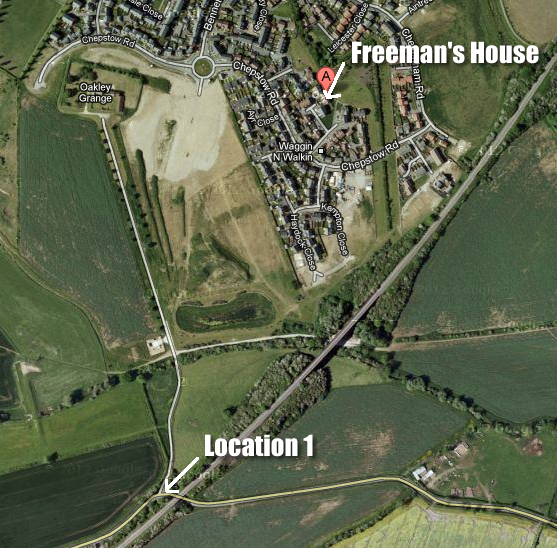
These were are original choice of settings, however when it came to having to get the actors and the equipment to the location, this is when it became a problem, as the location is a bit out of the way along a country road meaning we had to have a rethink of where we would film. In the end we decided to film somewhere a lot closer to home, in fact it was right behind my house. This gave us the perfect place to film as it was really close to my house so the equipment and the actors where not hard to transport.
There are pictures of the location below:
to come
We have uploaded a google maps image to display to you the logistical problem we were having:
For the music in our production we wanted to use something that was relevant to our storyline, this meant me and my partner looked back to find what was the number one hit in August of 1961, we found out that it was a song called 'You Dont Know' by Helen Shapiro. This provided us with a subtle yet clever intertextual reference. However, to require the use of the music though we had to contact the owners/representatives of the song.
The company that we found to own the song was EMI Records so we found the contact details so that we could acquire the rights to use the song. We decided to contact the company first via the phone as we thought it would be difficult to get a response quickly enough via email. We were forwarded on to someone who told us to contact them directly via email to find out if the use of the song was plausible. He first said that the chance of using the song would be high. The conversation is below: ---------------------------------------------------------------------------------------------
Hello, I am the student who just rang regarding the use of Helen Shapiro's You Don't know for my AS Level Media Production. If you could reply with written permission that would be greatly appreciated.
It appears this song is owned by Lorna Music Co Ltd for the publishing side. You may have been looking for EMI Records, who may own the recording. I would suggest you contact Jessica for this- 'REMOVED FOR PRIVACY'.
I am writing to enquire about the use of a song owned by Lorna Music Co Ltd in my AS level Media Production and was informed by a member of your publishing team that I should contact you for permission. The song in question is You Don't Know by Helen Shapiro and I guarantee that it will be used entirely for non-profit and educational use and if necessary we can provide you with our online e-Portfolio's to prove it's use.
Thank you for getting in contact to use Helen Shapiro “You Don’t Know” in your media production. So that I can process your request can you please answer the questions in red below?
SCHOOL/UNIVERSITY: To which school or university is your project to be submitted for marking?
PROJECT: What is the name of your project?
RECORDING & ARTIST: “You Don’t Know” performed by Helen Shapiro
DURATION AND NATURE OF USE:How much of the recording do you require? (e.g. 30 secs, 1 min, full duration of the recording) Will the recording be used solely in the background accompanying visual images?
MEDIA:Is the use purely for marking purposes?
TERRITORY:Is it solely UK for which you need rights?
TERM:How long do you require the rights? 6 months, 1 year?
COMMENCEMENT DATE:When do you require the rights from?
PROJECT SYNOPSIS (Please supply visuals if available):
Please do not hesitate to contact me if you have any further queries.
PROJECT: AS Level Media Production - Trailer for own film creation
RECORDING & ARTIST: “You Don’t Know” performed by Helen Shapiro
DURATION AND NATURE OF USE:One minute - Shall be featured in the background as an intertextual reference due to the film being set in August 1961 when it was a number 1 hit.
MEDIA:Purely for marking and educational, though it will be posted on You Tube so that it can be linked to our Portfolio's for moderation.
TERRITORY:It shall be posted on You Tube so I assume we will need rights for all that can view it, if that is possible?
TERM:Once it has been uploaded to You Tube we had not planned to remove it so if it's possible we'd like the rights as long as possible if not indefinitely?
COMMENCEMENT DATE:Though it will not be uploaded today, I'm not aware entirely when the finishing date of the project will be, so if possible commencement date would be from your acceptance today or when that is.
PROJECT SYNOPSIS (Please supply visuals if available): The project is for our coursework and is to create a film trailer for a thriller. Our film is about a copycat of the A6 Murderer from 1961; to enforce this we show at the opening of the trailer snippets of the original murder with Helen Shapiro's song playing in the background as if from a car radio to set the time period. I'm afraid the film isn't shot yet though I have attached the storyboard that the music will be applied to. I'd like to add that we would be perfectly happy to link to EMI and/or a link to buy the song in the description and plan to give complete credit in the credits and description.
Thank you very much for your time, I hope you can grant us the use of the song.
Please accept this email as confirmation that EMI Records Limited ("EMI") has no objection to your request to use up to 1 minute of “You Don’t Know” by Helen Shapiro (the "Artist") as you have described solely in connection with your school coursework, PROVIDED that at all times:
(i) Your school coursework is not exploited commercially in any way and is not used in any sort of commercial context;
(ii) Your use of the sound recording referred to above in your school coursework is in no way derogatory towards EMI, its affiliates or the Artist;
(iii) Your school coursework is in no way derogatory towards EMI, its affiliates or the Artist;
(iv) You only use the sound recording referred to above in the manner that you have described for 1 year from the date of this email and solely within the UK; and
(v) The Artist or their management do not at any time after the date of this email raise objections to your use of the sound recording in your school coursework.
This was fantastic news for our production as it means that we would be covered for the use, however, we cannot upload it to YouTube and therefore cannot link to our blogs. This means that we will have to send the exam board the Helen Shapiro version and record a similar version for use online.
Since me and my partner first created our blog we set out to create a trailer meaning most of the content is in relation to producing a trailer, however things have arisen that meant we had to alter our original brief. Once we had produced the final trailer we should a few people the trailer to get their feedback, their comments are below:
Audience Member 1: "I really like the shots and filters, though I think it's possible you're giving away too much of the storyline."
Audience Member 2: "The footage is perfect, but I think for a Trailer it lacks pace and really looks like the opening sequence of a film."
Audience Member 3: "I love the storyline, but most trailers don't reveal as much which could be a real downside."
After receiving this feedback which all clearly stated that our project, with some minor tweaks, looked more and more like a opening sequence than a trailer. We hence then found out that we could change the brief from creating a trailer to the first 2 minutes of a thriller film. After doing the minor tweaks we ended up with a film we were both extremely happy with.
Another prop that is need for our production is the murder weapon, and for this to fit in with the storyline of the film it has to be a gun. This means we needed a realistic firearm, but because of this it made it a necessity for us to have to read up on the law regarding the imitation and toy firearms. The legislation is below:
Code of Practice for Toy Firearms (V1.0)
"The Violent Crime Reduction Act, amongst other things, amends firearms legislation to ban the
manufacture, import and sale of realistic imitations and prohibits the sale of any imitation firearm
(whether or not it is realistic) to persons under the age of 18 years. Longer sentences have been
introduced for the possession of an imitation firearm in a public place without reasonable excuse. "
These details mean that we were unable to find a realistic firearm, without blowing the bank, plus if we are to have a realistic weapon we need to make sure that anyone in the vicinity is fully aware that the prop is being used for filming purposes only.
This meant what we decided to do was buy a children's toy gun that followed the UK Law and alter it to meet our needs. The gun we bought was originally blue and bought from Pound world To alter it to what we need we took it apart, removed the orange plug at the end and then sprayed it Matt black to look more realistic the result is below:
There is only one scene in the production that requires the gun to be taken out into a public place, however, when we do this we will notify anyone in the vicinity that it is a fake firearm being used for filming purposes, we will also try to film as quickly as possible.
The gun must also need to be used as photography prop inside an evidence bag, the picture we took is below. We used a sandwhich bag to make it look like and evidence bag and then to make it look more convincing we edited it by adding the text 'police evidence bag' and a barcode and changed it to black and white.
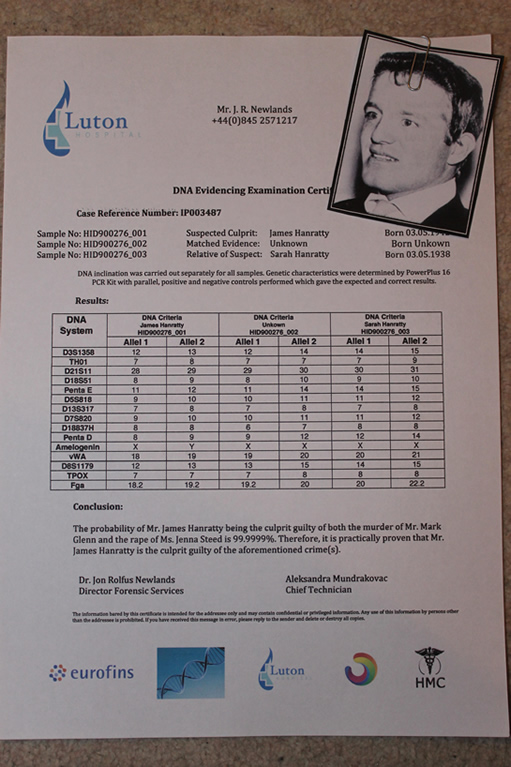
For our production, in one scene we require a DNA certificate to make the scene look more convincing and to prove that the murderer is James Hanratty. Me and Ross, researched into similiar products to get some inspiration to design our own. Below is the word document and the finished assembled version.
To help me and my partner in the imminent production of our thriller trailer we have decide to make a draft script that will form the base of our production, it outlines what roles need to be played and the voiceover of the trailer, although they are most likely to change and be improvised. The following scripts are below: Script Key PCI - Police Chief Inspector FS - Forensic Scientist
Script 1 - Conversation between PCI and FS about victim
FS: One Fatality, one raped and seriously injured, currently in intensive care, though don't expect anything soon. Mark Glenn, we knew him, Pathologist, do you remember? God, third one this month.
PCI: Yeeah, right, send your men home; you won't find anything.
FS: *Looks puzzled*
Script 2 - Sound Bridge of PCI that runs along most of the trailer
PCI: On the 22nd of August 1961 Michael Gregsten and Valerie Storie's car was hijacked off the A6. The hijacker later shot Gregsten before raping and shooting Storie. I think you'll agree, this isn't a homicide... it's a reenactment. Mark, happens to have been one of the Pathologists who resolved the original case in 2002 with DNA evidence, as were the others. The victims car was found abandoned in Ilford the same day, sporting no evidence, whatsoever. Enforcing this, the murder weapon was found by a cleaner on the backseat of a bus, again... no evidence. James Hanratty was the prime suspect throughout the investigation despite such a resounding lack of evidence; he was later hanged after being found guilty.
However... there was always significant evidence that lead towards a second suspect...
Script 3 - Discussion of DNA results between PCI and FS
FS: I have the results of the DNA testing, but you're not going to like it.
PCI: Well?
FS: It seems your murderer is dead... and has been for over fifty years
The A6 Murders(Quoted from the James Hanratty Wikipedia Article)
The Facts
At about 06:45 on the 23rd of August 1961, the body of Michael Gregsten was discovered in a lay by on the side of the A6 near Deadman's Hill, near Clophill. He had been shot at point blank range twice by a .38n revolver. Lying beside him was his semi-conscious mistress Valerie Storie. She has been raped and then shot 5 times, 4 in the shoulder and one in the neck, this caused her to become paralyzed below the shoulders.
The evening post the murder, the care that Valerie and Michael had been in that night was found abandoned behind Redbridge Tube Station in Essex. The car had been jointly owned by Gregstens Mother and his and Aunt and lent to him for what Valerie said was a supposed 'Car Rally'. Michael and Valerie worked at the same laboratory, he was a scientist and she was an assistant and they had been having an affair which didnt become public knowledge until much later.
The killer was suspected two be one of two people, either Peter Louis Alphon or James Hanratty, during the trial both of them changed their version of events several times, making it difficult for the judge and jury to make a decision. However, they decided that James Hanratty was the criminal and sentenced him to death, even though Valerie failed to pick him out of a line up. James Hanratty was one of the last people to be hung for his crimes in the United Kingdom.
The Appeal
Although James Hanratty was sentenced to death for the acts he committed during the A6 Murders, there was always much speculation that he wasn't the killer. This provoked an appeal by his family in 2002, due to the introduction of DNA evidence. The case was reopened and DNA gathered from James' corpse and his family. The evidence gave the judge no choice but to say that James Hanratty was the killer 'Beyond Doubt'.
However, his family still believe in his innocence and claim that the DNA evidence could have been contaminated because it has been in a scientific lab for 41 year and the DNA from his corpse could be corrupted. Our Idea Our storyline consists of the reenactment/copycat of the A6 murders in which they are now set in the modern day, however, once they do find DNA of the killer on the victims, they discover that it is actually the DNA of the original A6 murderer James Hanratty who has been dead some 41 years... In 2002 Hanratty, who was the original killer was proved guilty by DNA evidence which was not available at the time of the first trial. This means that for Hanratty to be the killer now the DNA Evidence must have been tampered with. To enforce it one of the victims of the case, is one of the Pathologists who worked on the original Hanratty case, this adds tension to the plot and implies a tick list type ideology to the film as the dead pathologist is one of many in the recent times. This shows that it is obvious that the killer doesnt agree with the result of the original case. We have decided to call our production film 'Deadman' as the original murders happened on Deadman's Hill so acts like a play on words and the proved killer in the reenactment is James Hanratty who is now a 'Dead-man'
Our filming, and production schedule is very tight and involves the use of adult actors throughout, this means to film these actors in the appropriate lighting, and to consider with the actors working lives and school work means we have to leave school during a free period on Friday 23rd of November. In order to acheive this, we had to gain permission from the school, this involved approaching our Vice Principal, Mr Bernard. Before approaching him we asked our Media Teacher, Mr Seston to write us a a formal letter giving his own permission that we could give to Mr Bernard. Below is the written letter and the printed signed letter: